The 100th Objectivity

I'm really pleased that today we've posted the 100th episode of Objectivity - and it's a special object indeed.

You may have seen in the news last week that a first edition of Issac Newton's Principia Mathematica sold for £3.7 million.

Well in our latest video have another first edition (a better one in my opinion, because of who owned it).

But we also have THE ORIGINAL MANUSCRIPT - handwritten with notes and used by the printers.

One of the greatest treasures in science - Isaac Newton's "Principia" - was nearly thwarted by a book about fish. Royal Society head librarian Keith Moore and explains to Brady Haran.

On the same day we posted episode 100, the channel also reached the milestone of 100,000 subscribers.

Thanks to everyone who subscribes, and if you do not subscribe then here is a link!

Several people have helped make Objectivity a success (and great fun).

I'd especially like to thank the Royal Society Library Team, most notably cult hero Keith Moore and Rupert Baker.

Also at the Royal Society, Tracey Hughes, Lesley Miles and Julie Maxton.

The very cool and curious Jake Chudnow at YouTube/Google who got things happening at the start.

And last but definitely not least, James Hennessy who films and edits the videos. He does an amazing job.

PS: Thanks to these guest stars too (click their names to see them on Objectivity)
Sir Paul Nurse, Michael Stevens (Vsauce), Anson at Nasa, J Willgoose Esquire (Public Service Broadcasting), Lucie Green, Charlie McDonnell, Festival of the Spoken NerdSteve Mould, Helen Arney, Matt Parker, Destin Sandlin (Smarter Every Day), Don Pettit (astronaut), Hannah Fry, Mike Merrifield, and Sir Martyn Poliakoff.

Shooting Number 100 with Keith and James

Shooting Number 100 with Keith and James

Four new elements

Earlier this year four new element names were proposed. We did a short video at the time.

But now the names are official, so that means four new films for Periodic Videos.

For fun we have released them all at once.

NIHONIUM - 113 - Nh

Nihonium, element 113, has been named after Japan. Videos on all 118 elements: http://bit.ly/118elements Moscovium: https://youtu.be/ewQAJtbgr7w Tennessine: https://youtu.be/1RGlXh9eC5E Oganesson: https://youtu.be/VMv44bIBdQI Discussed by Professor Sir Martyn Poliakoff at the University of Nottingham.
Element 115 has been named Moscovium, after the city of Moscow. Videos on all 118 elements: http://bit.ly/118elements Nihonian: https://youtu.be/-HcSEKuYGM8 Tennessine: https://youtu.be/1RGlXh9eC5E Oganesson: https://youtu.be/VMv44bIBdQI Discussed by Professor Sir Martyn Poliakoff at the University of Nottingham.
Element 117 was synthesised in Russia but named after Tennessee because of the crucial role played by the Oak Ridge National Laboratory. A video on every element: http://bit.ly/118elements Nihonian: https://youtu.be/-HcSEKuYGM8 Moscovium: https://youtu.be/ewQAJtbgr7w Oganesson: https://youtu.be/VMv44bIBdQI Discussed by Professor Sir Martyn Poliakoff at the University of Nottingham.
Element 118 has emerged from controversy in the late 1990s to be named after super heavy element pioneer Yuri Oganessian - a living person. More element videos: http://bit.ly/118elements Super heavy elements: http://bit.ly/super_heavy Nihonian: https://youtu.be/-HcSEKuYGM8 Moscovium: https://youtu.be/ewQAJtbgr7w Tennessine: https://youtu.be/1RGlXh9eC5E Seaborgium: https://youtu.be/UWq0djr790E Discussed by Professor Sir Martyn Poliakoff at the University of Nottingham.

Memorial to Caesar

Caesar was my dad's tracking dog during the Vietnam War.

A statue of Caesar has just been unveiled at a railway station in Sydney, near the site of the former Ingleburn Army Camp where he was based pre-service.

Dad Peter (in white shirt) and other handlers with the statue

Dad Peter (in white shirt) and other handlers with the statue

Vietnam War veteran (and my dad) Peter Haran on how tracking dog Caesar saved his life. Film by Brady Haran. Trackers (the best-selling book by Peter): http://bit.ly/TrackersBook More on land mines: http://youtu.be/PUCOHxun7LI Great resource on Australian Military history: http://bit.ly/AusWarMem Mini glossary...

A second video about Caesar in Vietnam should be coming soon.

The sculptor

The sculptor

My dad wrote a great book about his experiences with Caesar during the war. It is called Trackers and well worth a read if you like either military stories or just great dog tales!

Peter and Caesar

Peter and Caesar

Caesar in Vietnam

Caesar in Vietnam

See also Caesar drawing and dog tag at the Australian War Memorial.

Tragic Deaths

By coincidence we've had a lot of unfortunate deaths on Objectivity in recent weeks.

Most recently, chemist John Daniell who had a stroke at a Royal Society Council meeting. 

His colleagues made the bloody decision to open his jugular there in the meeting room. It did not help.

Professor Sir Martyn Poliakoff FRS joins Brady and Keith again to read an account of the tragic sudden death of John Frederic Daniell FRS. Subscribe to Objectivity: http://bit.ly/Objectivity_Sub Films by James Hennessy and Brady Haran Royal Society website: http://bit.ly/Royal_Society The Royal Society's own YouTube channel: https://www.youtube.com/user/RoyalSociety Facebook: https://www.facebook.com/ObjectivityVideos Twitter: https://twitter.com/objectivity_vid

We also told the story of esteemed scientist John Tyndall who met his demise at the hands of his own wife in a bedside mishap.

Brady and Rupert look at two portraits and discuss the sad story of Royal Society fellow John Tyndall's death.

And finally Francis Vernon - an intrepid traveller who saw amazing things but came unstuck in an argument over a pen knife.

Brady and Rupert take a look at a very special journal kept by Francis Vernon FRS - a 17th Century traveller. Subscribe to Objectivity: http://bit.ly/Objectivity_Sub Films by James Hennessy and Brady Haran Royal Society website: http://bit.ly/Royal_Society The Royal Society's own YouTube channel: https://www.youtube.com/user/RoyalSociety Facebook: https://www.facebook.com/ObjectivityVideos Twitter: https://twitter.com/objectivity_vid

If you enjoy tales like these - and cool bits of science treasure - do consider watching more from Objectivity.

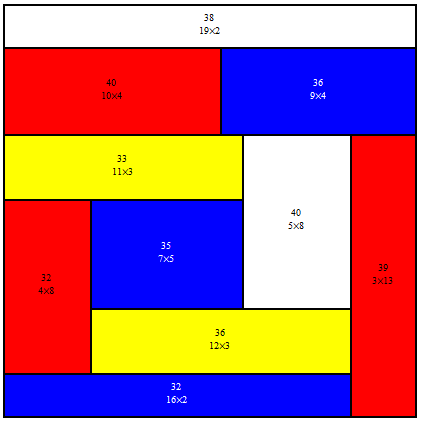
Mondrian Art Puzzle

The latest Numberphile video concerns a math puzzle based on the artworks for Piet Mondrian (Scroll to bottom of post for some corrections and updates)

Here's the video featuring Gordon Hamilton:

Featuring Gordon Hamilton from Math Pickle. Read more at this link: LINK TO COME Thanks also to Ed Pegg Jr.

More can be found at Gord's Math Pickle website.

A man who has done some additional work in this area is Ed Pegg Jr.

I had some useful correspondence with him. This demonstration created by Ed is very useful.

And some of our correspondence is shared below with his permission.

---

I'm using two methods.  The numerical one can start with the areas of all rectangles that can be cut from a square.  For example, the 9x9  can have subrectangles of area 1, 2, 3, 4, 4, 5, 6, 6, 7, 8, 8, 9, 9, 10, 12, 12, 14, 15, 16, 16, 18, 18, 20, 21, 24, 24, 25, 27, 28, 30, 32, 35, 36, 36, 40, 42, 45, 48, 49, 54, 56, 63, 64, 72, 81.   One easy cut is 4x5 and 5x5, for a difference of 9.  So look for all ranges less than that, and see if they can be put back together.  
The other method uses graphs.  The number of graphs gets high fast.
http://www.numericana.com/data/polycount.htm  

For example, 1000 by 1000 might need 35 rectangles, with 5986979643542 graphs to check through.  But it might be more. 

Both methods become computationally difficult pretty quickly.  I'm not sure which of my solutions up to 32 can be considered unbeatable. I was just trying for a hard-to-beat baseline.  It probably wouldn't be too hard to do a numerical analysis of the existing solutions and check to see if there was a smaller range that might yield a solution.  

---

I should start by mentioning the Mrs. Perkin's Quilt problem.  For a given square, divide it into smaller squares so that the sizes are relatively prime. Solved for smaller values back in the 1950's.  I use the old programs on new computers and extended the results.  Details of the older programs at squaring.net.


http://demonstrations.wolfram.com/MrsPerkinssQuilts/  
From a crushed version of those squares, I developed the Mondrian puzzles  
http://demonstrations.wolfram.com/MondrianPuzzles/  
In PickleMondrain.nb, I give all the solutions I had up to 32.  
In mondrian.xmpuzzle, I give a set-up file for Burr Tools.
http://burrtools.sourceforge.net/    
Let's look at the 6x6.  The range of rectangles 4, 4, 5, 6, 8, 9  might be a solution.  Over in Burr Tools, you can use the 6x6 as a goal and then pick out the rectangles with those areas.  Note that you have two choices for the area 6 rectangle and can only choose one at a time.  Sometimes you might have 40 or more combinations to go though.  the 6x6 is solved readily.  
For the 9x9, there is a known solution with defect 6.  There is a possible split with areas 14, 15, 16, 18, 18.  With Burr Tools, we can prove that split is impossible.  So the 9x9 is proven optimal.  
For 10x10 to 17x17, I pretty much did that.  I may have missed a few combos somewhere, but probably not.  
For the 18x18, there is a defect 10 solution.  There are four area sets that might give a defect 8 solution.  I used Burr Tools to check all the combos, and none of them gave solutions.  So the 18x18 is proven optimal.  
For the 19x19 a defect 11 solution was known.  Just now, I looked at the promising defect 9 case, and found a solution with Burr Tools.   All of the solutions there had two rectangles sharing a full edge, so they wouldn't be found in a search of 3-connected graphs with the electrical method. 
For 20-32, it looks like there are many smaller cases I didn't check.  It would likely be possible to check through all of them by hand within a few days.  My gut feeling is that there might be 2 or 3 improvements if all cases and combos were checked.  

After doing these for a while, you start to appreciate complete sets of rectangles, because that usually means a low defect and only 1 combo to check.  For the 36x36, I noticed that the 24 rectangles of area 48 to 60 might work.  Burr Tools immediately found hundreds of solutions.  

Then I branched out into 3D.  Is it possible to make a polyhedron out of different rectangles?  I managed to do it with 30 rectangles.  

http://community.wolfram.com/groups/-/m/t/928487  
Is it possible to divide a square into different rectangles so that all the diagonal have the same length?  I solved that one, too.  
http://math.stackexchange.com/questions/1958738/same-diagonal-dissection  
Hope that helps.  
POST SCRIPT: After the video was published, Ed improved his 25x25 score from 12 to 11... Here is the result...
POST SCRIPT 2: Ed reports Bruce Norskog found an improvement to n(18).  Ed himself went through and rechecked everything, and also found improvements for n(15) and n(19).

OEIS Sequence: https://oeis.org/A276523

Rigged Elections?

With an eventful US Presidential Election about to take place, I had a timely chat with legendary cryptographer Ron Rivest.

These two videos were the result:

CHECKING ELECTIONS USING SAMPLES AND POLYA'S URN

Professor Ron Rivest discusses a technique for post election audits - taking small samples and using Pólya's Urn. See our other election video with Prof Rivest: https://youtu.be/BYRTvoZ3Rho Perils of e-Voting on Computerphile: https://youtu.be/w3_0x6oaDmI RSA Encryption: https://youtu.be/M7kEpw1tn50 Some recommended links from Professor Rivest...
How to be sure your vote was counted ---- "End to End Verifiable Voting" with cryptopgraphy expert Professor Ron Rivest.

If you've not seen it, this Tom Scott guest appearance on Computerphile is also well worth a look.

Voting is centuries old, why can't we move with the times and use our phones, tablets and computers? Tom Scott lays out why e-voting is such a bad idea. More from Tom Scott: http://www.youtube.com/user/enyay and https://twitter.com/tomscott http://www.facebook.com/computerphile https://twitter.com/computer_phile This video was filmed and edited by Sean Riley.

Various Halloween Videos

Here we go... Spooky stuff.

New this year, using Neil's Halloween Cauldron.

Hot charcoal in LOX, the whole process was filmed with a thermal imaging camera. Featuring Professor Sir Martyn Poliakoff and Neil Barnes. Our thanks to the Google Making & Science team.

And from previous years.

Three chemists do their best to destroy pumpkins using all the tricks up their lab coat sleeves! More chemistry at http://www.periodicvideos.com/ Follow us on Facebook at http://www.facebook.com/periodicvideos And on Twitter at http://twitter.com/periodicvideos Periodic Videos films are by video journalist Brady Haran
The periodicvideos team demonstrates a laser dye for Halloween. More chemistry at http://www.periodicvideos.com/ Follow us on Facebook at http://www.facebook.com/periodicvideos And on Twitter at http://twitter.com/periodicvideos Periodic Videos films are by video journalist Brady Haran
To mark Halloween we're discussing vampire numbers. More cool sciencey Halloween videos at http://www.youtube.com/playlist?list=PL9eEsN9D48mf8CIYU1wRnWak0lcAnJN1u This video features Dr James Grime and Professor Ed Copeland.
More mind-mending particle physics from the guys at the University of Nottingham. Happy Halloween? Visit our website at http://www.sixtysymbols.com/ We're on Facebook at http://www.facebook.com/sixtysymbols And Twitter at http://twitter.com/#!/periodicvideos
We discuss blood - both real and fake - for our 2010 Halloween special. Includes an explanation about hemoglobin, aka haemoglobin. More chemistry videos at http://www.periodicvideos.com/
Image credits below... For Halloween we look at a couple of "witch" objects in space.
The mysterious Neil drops red-hot charcoal into a cauldron of liquid oxygen.
Did you realise modern candle wicks are a marvel of engineering? The Professor takes a look at candle chemistry in this special video for Halloween. More chemistry at http://www.periodicvideos.com/ Follow us on Facebook at http://www.facebook.com/periodicvideos And on Twitter at http://twitter.com/periodicvideos Periodic Videos films are by video journalist Brady Haran