10958

New Numberphile with Matt Parker about the number 10,958 comes in two parts...

Part One, The Problem

Featuring Matt Parker... Part 2 (solution) here: https://youtu.be/pasyRUj7UwM More links & stuff in full description below ↓↓↓ Discuss this video on Brady's subreddit: https://redd.it/6628q2 We appreciate any help on Patreon - it lets us make a few more and better videos: http://www.patreon.com/numberphile Matt Parker on Numberphile playlist: http://bit.ly/Matt_Videos Matt's channel: http://bit.ly/StandUpMaths Parker Square T-Shirt: http://bit.ly/ParkerSquareTshirt Inder J.

Part Two, The Possible "Parker Squarey" Solution - I quite like like it, actually!

Previous video sets this up: https://youtu.be/-ruC5A9EzzE Extra on concatenation: https://youtu.be/LgnoYsbI7Uc More links & stuff in full description below ↓↓↓ We appreciate any help on Patreon - it lets us make a few more and better videos: http://www.patreon.com/numberphile Matt Parker on Numberphile playlist: http://bit.ly/Matt_Videos Matt's channel: http://bit.ly/StandUpMaths Parker Square T-Shirt: http://bit.ly/ParkerSquareTshirt Inder J.

There is also some extra footage on Concatenation.

Two related videos... 10,958 problem: https://youtu.be/-ruC5A9EzzE and 10,958 solution: https://youtu.be/pasyRUj7UwM Featuring Matt Parker... Four 4s: https://youtu.be/Noo4lN-vSvw Matt Parker on Numberphile playlist: http://bit.ly/Matt_Videos Matt's channel: http://bit.ly/StandUpMaths Parker Square T-Shirt: http://bit.ly/ParkerSquareTshirt Inder J. Taneja papers...

If you are wondering about references to The Parker Square, there is this video which COINCIDENTALLY was uploaded exactly one year ago.

Matt Parker reveals his pride and joy - the mysterious Parker Square! MORE LINKS IN FULL DESCRIPTION BELOW...

And this video featuring concatenation is also referenced in the videos.

It was a famous problem for many years - until a physics genius solved it all the way to infinity. Featuring author Alex Bellos - more links below. Extras from this interview: https://youtu.be/jv8dITbiheQ More Numberphile videos with Alex: http://bit.ly/Bellos_Playlist Alex's recent book about puzzles (including the Four 4s): http://amzn.to/2jRo0n2 More Alex books: http://bit.ly/BellosBooks With a sincere thanks to these Patrons...

The Collatz Conjecture in Colour

The latest Numberphile video is about the Collatz Conjecture - in particular a new way of visualising it.

Thanks to The Great Courses Plus for supporting the video

Inkthusiast Tiffany Arment did the coloring in!

The image is featured in the coloring book by Alex Bellos and Edmund Harriss called Visions of the Universe (USA NAME) and/or Visions of Numberland (UK NAME).

Click here for Alex Bellos books. (Amazon affiliate link)

Here is extra interview footage that was not used in the main video.

Main video: https://youtu.be/LqKpkdRRLZw Featuring Alex Bellos. More info in full description below. Coloring by Tiffany Arment: https://twitter.com/tiffanyarment Music by Alan Stewart.

And if you're feeling especially hard core, here's the full 63 minutes of Tiffany's coloring... It seemed a shame to not share it.

Main video: https://youtu.be/LqKpkdRRLZw Coloring by Tiffany Arment: https://twitter.com/tiffanyarment Our previous Collatz Conjecture video: https://youtu.be/5mFpVDpKX70 The Collatz Colouring image is included in the book Visions of the Universe (USA NAME) and/or Visions of Numberland (UK NAME).
Professor David Eisenbud on the infamous Collatz Conjecture, a simple problem that mathematicians may not be "ready" to crack.
Main video on Collatz Conjecture: https://youtu.be/5mFpVDpKX70 Riemann Hypothesis: https://youtu.be/d6c6uIyieoo Key to the Riemann Hypothesis: https://youtu.be/VTveQ1ndH1c Eisenbud 17-gon: https://youtu.be/87uo2TPrsl8 Fermat's Last Theorem: https://youtu.be/qiNcEguuFSA Bridges to Fermat (Ken Ribet): https://youtu.be/nUN4NDVIfVI NUMBERPHILE Website: http://www.numberphile.com/ Numberphile on Facebook: http://www.facebook.com/numberphile Numberphile tweets: https://twitter.com/numberphile Numberphile is supported by the Mathematical Sciences Research Institute (MSRI): http://bit.ly/MSRINumberphile Videos by Brady Haran Support us on Patreon: http://www.patreon.com/numberphile Brady's videos subreddit: http://www.reddit.com/r/BradyHaran/ A run-down of Brady's channels: http://www.bradyharan.com Sign up for (occasional) emails: http://eepurl.com/YdjL9

Periodic Videos trip to Russia

The main reason for our trip was the inauguration of three new elements - 115, 117 and 118.

Watch the video here:

The inauguration of Moscovium, Tennessine and Oganesson was held in Moscow on March 2, 2017. Professor Yuri Oganessian was there, and our own Professor Sir Martyn Poliakoff was among the special guests to make speeches. More videos from Russia soon. Music by Alan Stewart.

Here are some photos which tell the story of our trip... Captions are below each picture.

At the Joint Institute for Nuclear Research, in Dubna, the office of Georgy Flerov has been preserved as it was when he died in 1990. The calendar lies open (from a few of weeks before his death) and his reading glasses are on the table. Element 114 was named Flerovium in his honour.

Adjacent to Flerov's "museum office" is the office of Yuri Oganessian, who is still the world leader on superheavy elements. Element 118 was named Oganesson in his honour.

Oganessian is based at JNIR's Flerov Laboratory of Nuclear Reactions.

Professor Poliakoff sports a Russian tie for inauguration day.

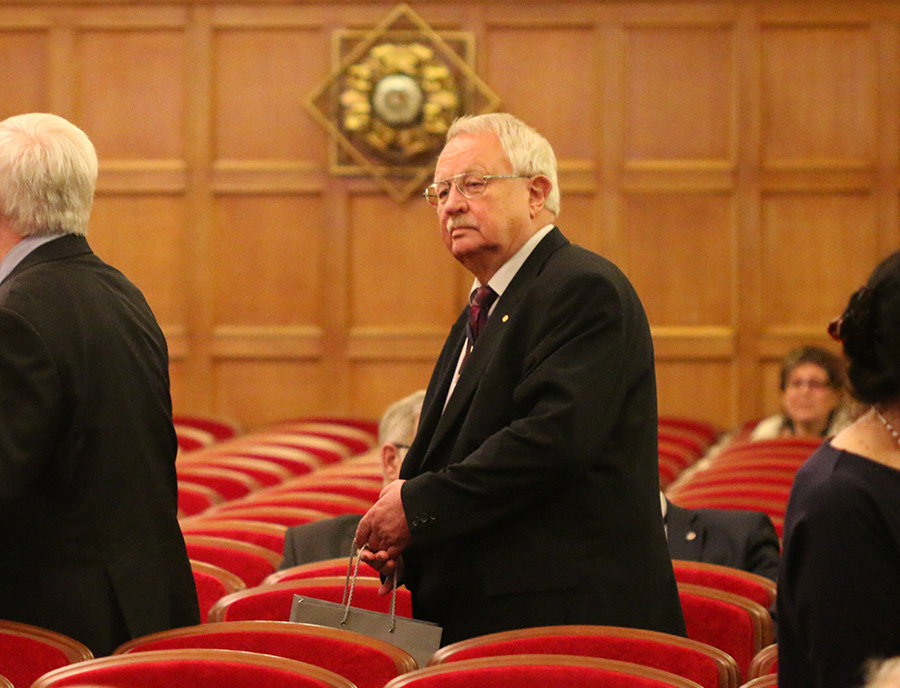
Prof Oganessian arrives at the Central House of Scientists, in Moscow, for the inauguration. Here's a video we made when the names were first announced.

Another element pioneer is there - Professor Sigurd Hofmann. We met him in Germany in 2010 to make videos about other superheavy elements. Watch him here.

Professor Oganessian delivers talk about the island of stability - and continues a great scientific tradition of using comic sans.

The President of the International Union of Pure and Applied Chemistry is Natalia Tarasova. IUPAC oversees the names of elements and it is her announcement that makes the new names "official'.

Professor Poliakoff takes to the stage and discusses our video project - and how it exciting it was when superheavy elements transformed the table.

Professor Oganessian watches as Professor Poliakoff describes him as a superhero and then gives him a superhero costume (see the video). 

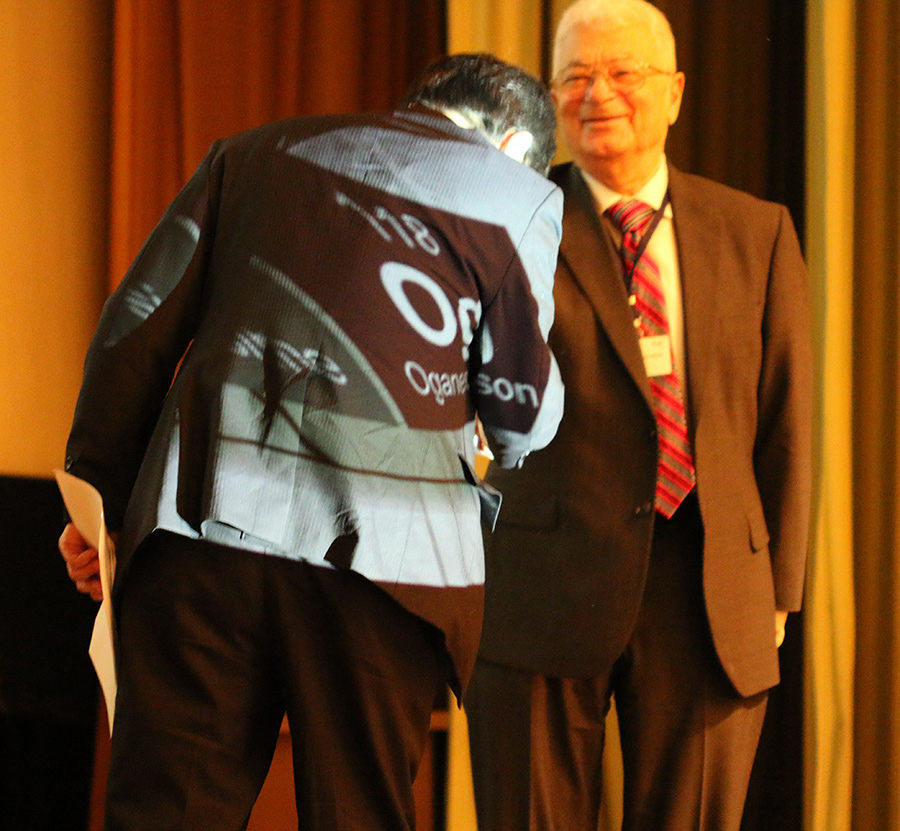
A series of VIP guests then make short speeches and shake Yuri Oganessian's hand.

Oganessian's name will live forever on the periodic table.

Scientists gather the next day for a tour of the facilities at Dubna and a short seminar about the future of element synthesis.

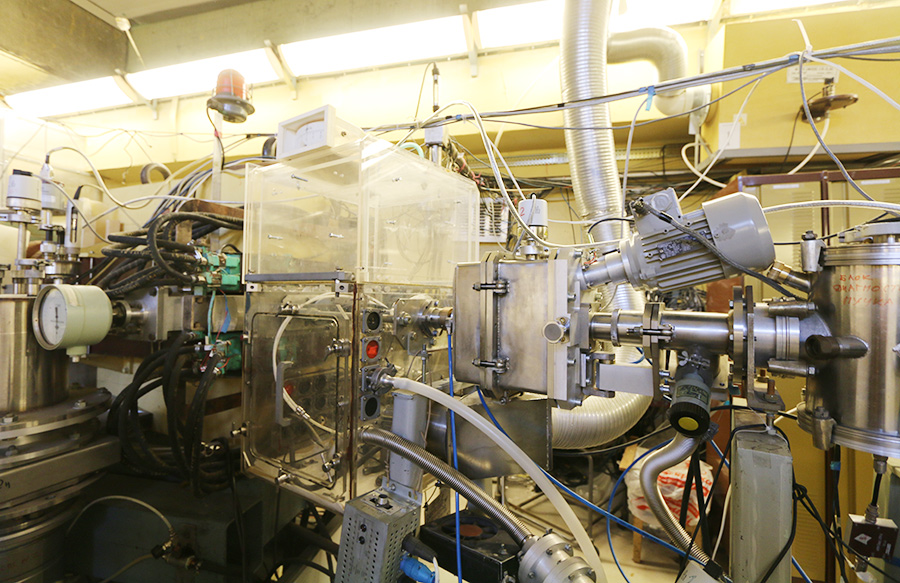
Filming with the professors. Behind them is the cyclotron which speeds the projectile isotopes (very often Calcium-48) to enormous speeds, then fires them down the beamline which is also visible in this photo.

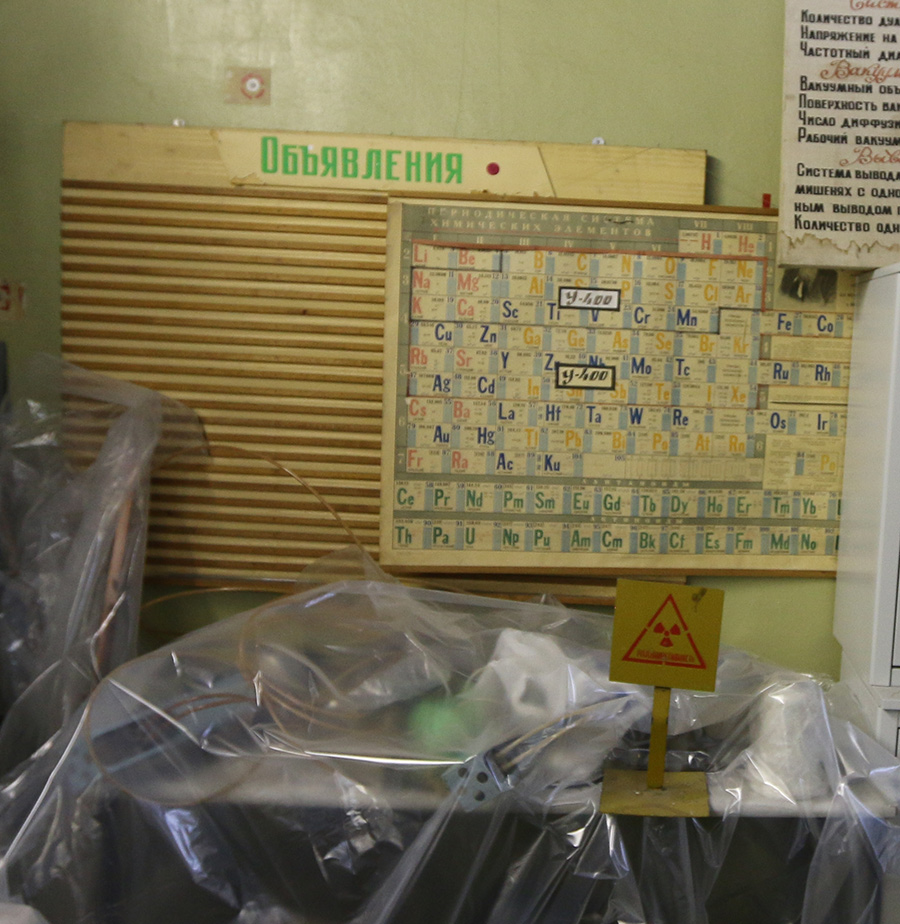
Funnily enough, the lab where the new elements have been made is adorned by this old periodic table which stops at element 104. We could not get any closer due to some radioactive equipment. You might note 104 was being called Kurchatovium (Ku) by Russians at this time.

Super heavy weights! Legends Oganessian and Hofmann chat with Professor Poliakoff.

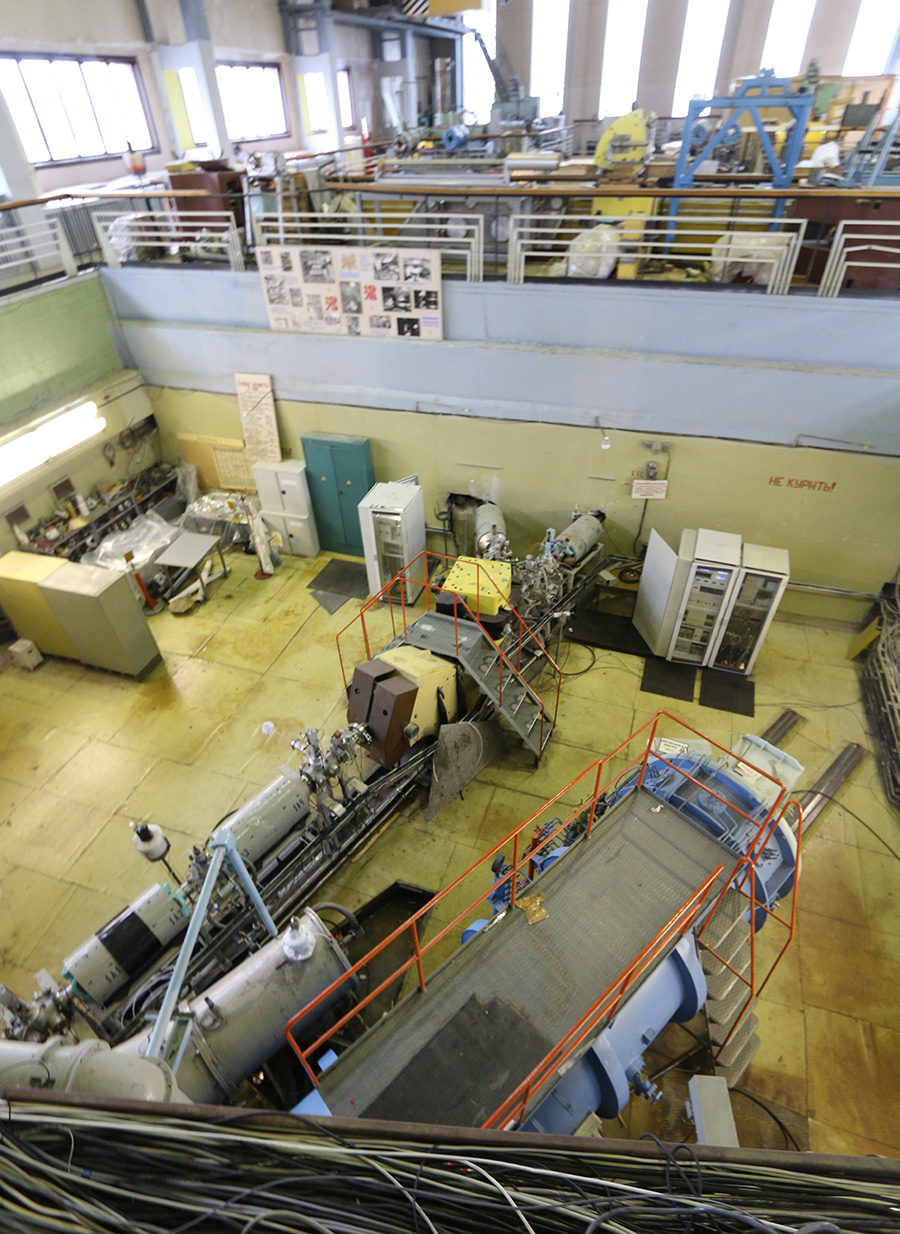
A better view of the cyclotron and beamline. Behind the blue box atop the cyclotron is where the isotopes are fed into the system.

Now standing atop the cyclotron, you can see the beamline and, beyond the blue wall, the area where the projectile isotopes will smash into the target.

About to film at ground zero. The beam of isotopes streams into the target area and then strikes the target wheel, which is laced with an exotic heavy element. The collision and subsequent fusion happens inside the clear box to the left of the professors. The newly-formed superheavy element then flies into the waiting detector.

Another look at the collision zone, taken from where we are standing in the previous photo. The actual collisions happen inside a secondary box which was not installed at this time.

The target material is loaded onto this fast spinning wheel. Each sector on the outer part of the wheel contains a piece of foil (see at the right) which is coated with a very thin amount of the heavy target isotope.

Professor Oganessian with a small piece of target. When being used, it is laced with an exotic element such as Californium or Berkelium.

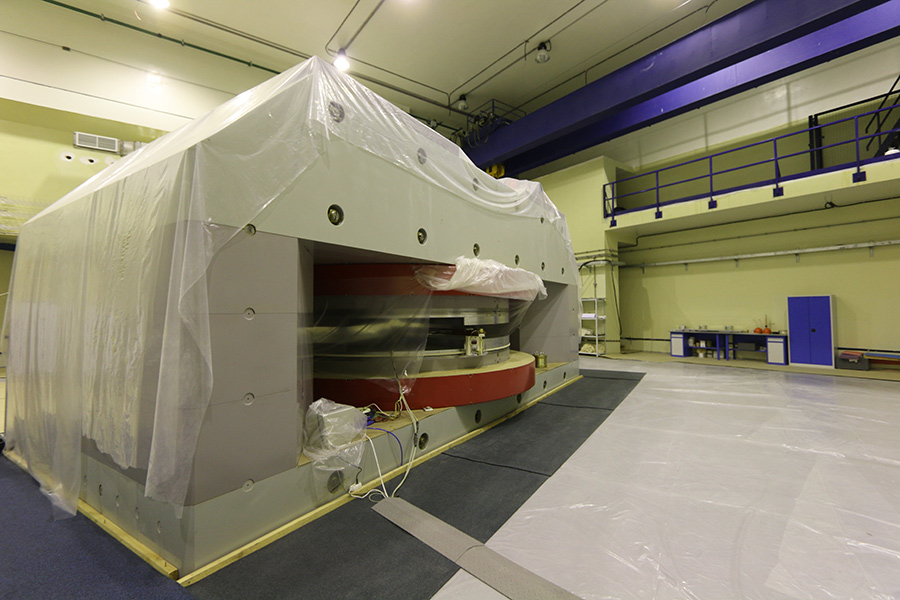
To make heavier elements, a better and more powerful set-up is needed. Here is the cyclotron under construction for Dubna's new Superheavy Elements Factory.

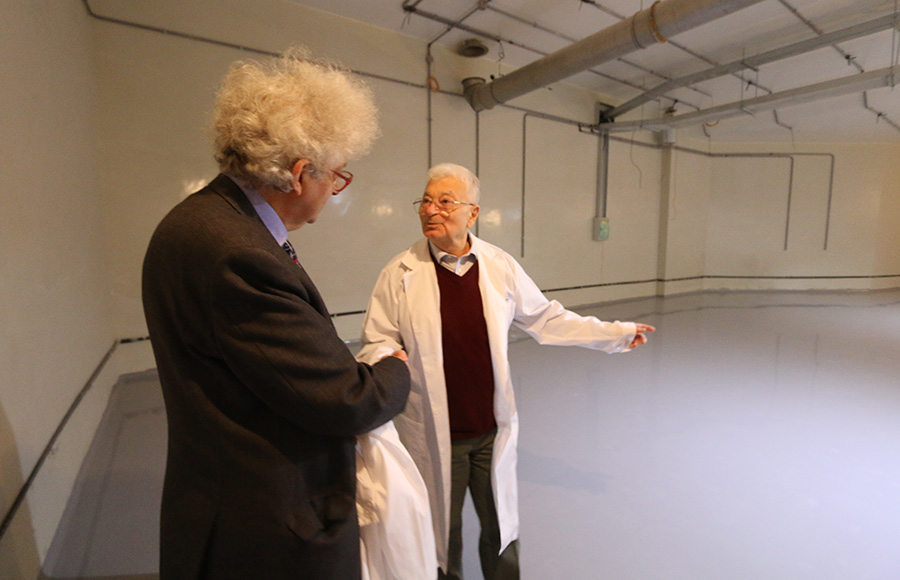
Oganessian peers into the void where, eventually, isotopes will be spun to enormous velocities and then slung towards targets.

The collisions will happen in adjacent rooms. The experiments and beamlines are not yet installed, but on the far wall you can see the holes in the wall which will eventually accommodate the beams.

View through the "beamline hole", looking back to the cyclotron in the adjacent hall.

So perhaps this is the room where elements 119 and 120 will be created - and maybe even elements beyond.

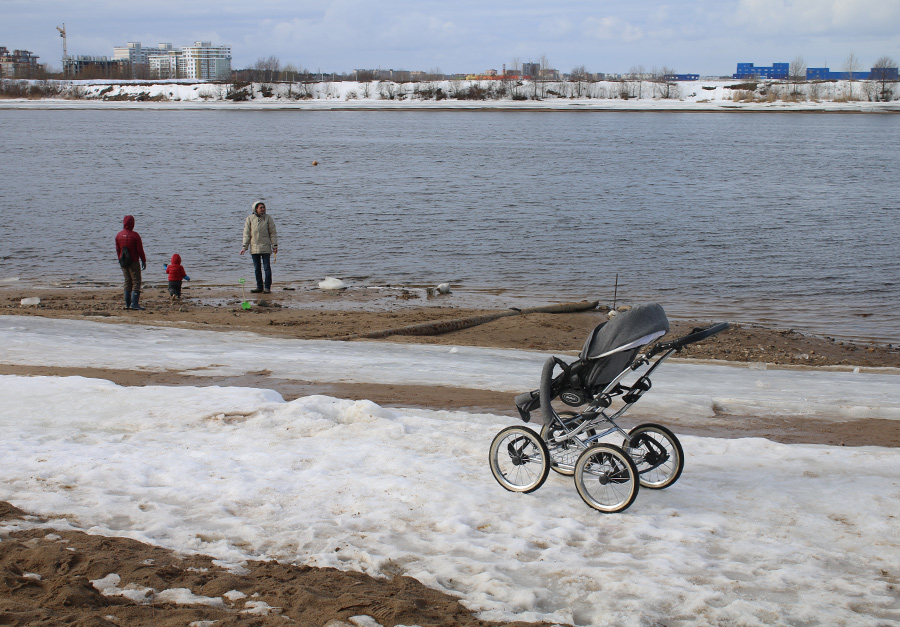
Dubna sits on the Volga River (Europe's longest) and includes a section called the Mendeleev Embankment.

The river attracts families at the weekend...

And occasionally visiting science professors.

Dubna has many monuments to its science pioneers.

Thank you to everyone at JNIR for hosting us - but especially Professor Oganessian who was very generous with his time.

Hearts on Valentine's Day

A Valentine's Day themed Objectivity video...

Well, sort of.

Keith and his library colleagues were suggesting love poems, but I requested we dig out the best images of hearts we could find.

Watch the video here:

It's a Valentine's Day special at The Royal Society! Brady wanted hearts, and this is what we found in the archives..

129-digit number

114,381,625,757,888,867,669,235,779,
976,146,612,010,218,296,721,242,362,
562,561,842,935,706,935,245,733,
897,830,597,123,563,958,705,058,
989,075,147,599,290,026,879,543,541

This number is better-known as RSA-129.

It was posted in a 1977 magazine article as a challenge.

The co-inventors of RSA Cryptography wanted to see just how hard it was to factorize a number (it was crucial to the new technology).

RSA-129 is created by multiplying two very large prime numbers.

Ron Rivest (the R in RSA) thought it would take 40 quadrillion years for the prime numbers to be found.

He was wrong. It took 17 years.

Watch the Numberphile video to learn more.

The large number "RSA-129" posed a challenge experts said would take 40 quadrillion years to solve - but took 17. Featuring Ron Rivest, co-inventor of RSA... More links below...

I also recommend the extra footage at Numberphile2, which is some extra questions I asked Professor Rivest.

This follows on from our RSA-129 interview with cryptography legend Ron Rivest.

Mathematics - Beauty vs Utility

Last year I met with mathematician Cedric Villani. He's somewhat of a celebrity, especially in his native France and the world of mathematics.

Professor Villani won the Field's Medal in 2010 and is director of Poincare Institute in Paris.

I've gradually been editing our interview into a series of videos - you can see them all on Numberphile's Cedric Villani Playlist.

The latest video is a discussion which started when I asked about a magic square on his blackboard... But the conversation then veered towards the beauty vs utility of mathematics?

Should mathematics be done for the sake of it - or should it be useful to society?

We also discussed why many mathematicians were considered poor at "outreach".

You can watch the interview at this video link. Or I have put a slightly edited transcription below...

Should mathematics be done for its pure beauty or should it have practical uses? And why are many mathematicians so bad at outreach? Discussion with famous French mathematician, Cédric Villani.

BRADY: I noticed one other thing, I noticed on your board you have a magic square.

VILLANI: Correct.

BRADY: Why is that there today?

VILLANI: You know I spend part of my life doing interviews and sometimes you have to vary things, you know, change a bit from the usual. And so in that interview this was to recall my initial interest in mathematics. When I was a kid, this was the kind of thing that I loved doing - magic squares. I think it’s one of the oldest mathematic memories that I have, doing large magic squares.  

A child can learn how to do this. And I often explain about this in the schools - it gives you some sense of mystery and power of mathematics and algorithmics.

And there you are Brady, see, it's magic.

BRADY: So basically this is to entertain journalists?  

VILLANI: That's correct. But a bit more than that.  In this particular case the interview was intended for children. If I tell the children “you know mathematics is so good of the GDP because it its so good for technology” and so on - not sure they will like it. But if I tell them when I was a kid, at your age, I loved to do this kind of figures and it was kind of making me dizzy in a way to see the properties of the numbers... This was my start - and then it became my job.

BRADY: How do you find striking the balance? Sometimes when you're talking to people about mathematics you have to talk about things like GDP and the important role it plays in society... And other times you just want to show someone a magic square and just excite them - is that not enough, exciting them? Does it frustrate you that you’re always having to come up with these justifications for mathematics?

VILLANI: You have to justify. Part of the reason is there has been some excess in the past, I guess, in insisting on mathematics for itself - mathematics for the the beauty of it - and somehow we have to insist also on the other side now.
But it's okay, you have to balance. Every time I say something about the utility of mathematics, I will balance it with something about its beauty.  And vice versa.

BRADY: It’s unusual to hear a mathematician talk like that, you sound almost half politician. You think that's important? Pure mathematics is not enough these days, you've got to sing for your supper?

VILLANI: In front of you is not just a mathematician, I'm director of an institute, already six years. For the past four years I have been supporting a project for expanding my institution and managed to raise 13-14 million Euros for that project. This can only be achieved if you know how to talk to society; talking to businessmen, talking to bankers, talking to politicians, talking to school masters, talking to everybody. If you don't manage to talk the way they understand, you will not become their friend.

BRADY: But when you were younger man doing some of the work you're most famous for - most awarded for - were you thinking like that then? Or were you just doing it for the pleasure and was it just about mathematics then?

VILLANI: You know when I chose my subject, Boltzmann Equation, my adviser wrote for me the Boltzmann Equation, okay one variant of the Boltzmann Equation, I asked is it useful and who used it? And for me at that time this was an important question. To know that it was important in the modelling of rarefied gases, important for construction of shuttles or planes or simulation of what goes on around the wing of the plane and so on. It was important for me. And later when I worked on it, I discovered I really loved it for the beauty of the study, that the more I was going into it and the more it was a world opening for me. It was a curiosity that was driving me then. But to get into it I first had to be convinced of its utility. There's no shame in something being useful.

Somehow it's a little bit of poison that Hardy has instilled in our minds, making us feeling ashamed of what is useful. These were other days, other times and different context. Now we should not be ashamed of what is useful and even understand that when it is useful it is even more beautiful.

There has to be some useful and some useless. Sometimes the useful becomes useless, sometimes the useless will become useful. There has to be room for all kinds of mathematicians and it's a big illusion to think that there is a real recipe to decide what has to be funded and what should not. You know you have to allow some uncertainty in the system. If you try to predict, you lose the most interesting parts.

BRADY: Do you think mathematicians are good at outreach. Do you think mathematicians are good at explaining themselves?

VILLANI: In general mathematicians are not so good at outreach. And there are reasons for that. Some reasons are related to the field itself; because we go into such details. You know even between ourselves, mathematicians, it is difficult to communicate. It's so hard to communicate between mathematicians of different specialties. To talk to the outer public, the outer audience, is an even greater challenge. You have really get to the point, understand what you want to share, and so on. 

Another reason is when you are into mathematics you have been so high on the scale of complexity of reasoning that you are living in some kind of altered reality. You think that everybody on the street is able to understand complicated reasoning and so on. And you get very frustrated when you discover that's not the case.

And then there's a third reason, I guess. Which has to do with, how do you say, the business model of mathematics so to speak. The physicists, the chemists, the biologists - they are often in contact with the industry. Or the people who run big teams, they have to negotiate budgets, fundings, with the big pharmacy companies, or with the big sponsors, otherwise they don't have enough funding for the experiments and so on. And so they their learn to --- their rhetoric and speech and so on.

It struck me when I first attended the conferences of Nobel Prizes how good were some of the people, Nobel Laureates, in physics and biology, to present themselves. And I attributed that to the fact that they had to do it already many times for the funding in their career to people who were really out of their world, and it was very important to convince those people to trust them.

BRADY: And historically mathematicians don't need as much funding?

VILLANI: Historically we don't need the companies, historically no such need for support. I need the companies now because I am working on this outreach interface. We are soon opening some kind of museum of mathematics - soon means in three years or something. This will be impossible without the contribution of the industry, the economic world, so I had to learn to talk to them otherwise my projects could not have come into life.
 

Best of 2016

These are some of the videos I've been involved with making with during 2016.

It's an arbitrary combination of popular ones and my own favourites.

Lithium in 7Up: Dropping a sample of Lithium into soft drink!

7 Up's original recipe contained Lithium - so what happens if you drop Lithium metal into modern 7 Up... The results surprised us.

The Josephus Problem: Helped by a great animation by Pete McPartlan.

The Josephus Problem, featuring Daniel Erman from University of Wisconsin-Madison. Winning at Dots and Boxes: https://youtu.be/KboGyIilP6k NUMBERPHILE Website: http://www.numberphile.com/ Numberphile on Facebook: http://www.facebook.com/numberphile Numberphile tweets: https://twitter.com/numberphile Subscribe: http://bit.ly/Numberphile_Sub Numberphile is supported by the Mathematical Sciences Research Institute (MSRI): http://bit.ly/MSRINumberphile Correction: Around 9:40 that should be L less than 2^a NOT 2a --- Sorry, typo in editing!

Principia: A special video for Objectivity #100. Released the same day the channel reached 100k subscribers.

One of the greatest treasures in science - Isaac Newton's "Principia" - was nearly thwarted by a book about fish. Royal Society head librarian Keith Moore and explains to Brady Haran.

Burning Iron in LOX: One of the prettiest experiments of the year. Nice slow motion.

Burning iron is dropped into liquid oxygen. Raw footage (reactions 1-4): https://youtu.be/TcBog29fSbo Raw footage (reactions 5-8): https://youtu.be/tMYqgofSp0Y Reactions by Neil Barnes. Discussion by Professor Martyn Poliakoff.

e: Finally, a Numberphile video focusing on this crucial constant. Featuring James Grime.

Free trial at The Great Courses Plus: http://ow.ly/tKWt306Gg7a Dr James Grime discusses "e" - the famed Euler's Number.

Paperclip Tricks: We started a whole series of videos with Tadashi Tokieda.

Featuring Tadashi Tokieda.

Biggest Prime: When a new biggest prime number was discovered, Matt Parker printed it.

Matt Parker on the latest Mersenne Prime to take the title of "world's biggest prime". He had it printed! More from this interview very soon, including details of how the prime was found.

Moon Trees: Just a fun little video made possible (and much more fun) by my mate Destin from Smarter Every Day.

Brady and Destin go in search of Moon Trees. Space Wood via Objectivity: https://youtu.be/Z58ULnlRjXE Destin's channel: https://www.youtube.com/smartereveryday More tree videos by Brady: http://bit.ly/TreesPlants More on Moon Trees from Nasa: http://bit.ly/Moon_Trees (includes locations) Cheers Mike Merrifield for suggesting the topic. Thanks to Destin Sandlin and his road crew!
Famous mathematician Hannah Fry takes a lucky dip into the vaults at The Royal Society. Hannah's website: http://www.hannahfry.co.uk Subscribe to Objectivity: http://bit.ly/Objectivity_Sub Films by James Hennessy and Brady Haran Royal Society website: http://bit.ly/Royal_Society The Royal Society's own YouTube channel: https://www.youtube.com/user/RoyalSociety Facebook: https://www.facebook.com/ObjectivityVideos Twitter: https://twitter.com/objectivity_vid

More white gloves: The Festival of the Spoken Nerd also don the gloves in a group effort. Thanks to Steve, Helen, and Matt.

The Festival of the Spoken Nerd take the Royal Society "lucky dip" by randomly choosing items from the card catalogue.. What will they find?!

Dipping Birds: Using a thermal imaging camera, which is a new acquisition and proving to be fascinating.

Taking a closer look at dipping birds with a thermal imaging camera. Our thanks to the Google Making & Science team. More #ScienceGoals videos at: https://www.youtube.com/playlist?list=PLIsr6chyjBJutgMPQ18jHPyejaOxklf9A Thanks to Professor Philip Moriarty... See his video from 2009 at: https://youtu.be/KUvHzFm29cg Music by Alan Stewart.

Three Gears: One of several videos with 3D math printing guru Henry Segerman.

Henry Segerman (mathematician and 3D printing guru) discusses how to make three gears work together.

Moving the South Pole: Our friend Denis Barkats filmed a bunch of footage in Antarctica which we've gradually been editing into nice science videos.

Each year the geographic south pole marker is moved (and replaced) as the Antarctic ice slides across the continent. This year we had a man on the scene - astrophysicist Denis Barkats. More videos from Denis at the pole are coming soon.

Whirlpool Galaxy: Deep Sky Videos continued its gradual path through the entire Messier Catalogue.

Messier 51, The Whirlpool Galaxy, and how its spiral arms were formed. Featuring Professor Mike Merrifield. EXTRA FOOTAGE: https://youtu.be/dHLpUOXU2S4 More Messiers: http://bit.ly/MessierObjects Telescope Tours: http://bit.ly/telescopetours Deep Sky Videos website: http://www.deepskyvideos.com/ Twitter: https://twitter.com/DeepSkyVideos Facebook: http://www.facebook.com/DeepSkyVideos More about the astronomers in our videos: http://www.deepskyvideos.com/pages/contributors.html Made possible by: The University of Nottingham and The University of Sheffield.

Classic Hello Internet: There were lots of Hello Internet episodes - this was a "classic one", we claimed?

Subscribe to the Podcast: http://goo.gl/CemLaj Grey: https://www.youtube.com/user/cgpgrey Brady: https://www.youtube.com/user/numberphile Discussion: http://www.reddit.com/r/CGPGrey/ Brady and Grey discuss: Snapchat again, emoji flags, Tesla, Brady's papercuts, plane crash corner, and health corner. And also Brexit, long after the discussion could possibly be relevant. ## Brought to You By Fracture: Photos printed in vivid color directly on glass.

Doctor of Letters: My own highlight of the year - becoming Dr Brady thanks to the University of Nottingham.

Doctor of Letters honoris causa conferred by the University of Nottingham. Oration by Professor Michael Merrifield.

Thanks to everyone who watched any of these and other videos during the year. I would not get to make these if it was not for you taking the time to view them!

And thanks also people who contributed via Patreon or by buying a flag, T-Shirt or vinyl record!

With YouTube subscriptions doing weird things these days, I always make sure the very best videos are included on occasional emails... If you'd like to subscribe to my email list, I'd be really pleased.